From Frontend/Backend to a Spectrum: Drawing a Clear Map for the Chaotic AI Talent Market
The age of AI has arrived, but the job market seems to be lost in a fog. The “Machine Learning Engineer” at Company A does the work of the “AI Engineer” at Company B, while the “Data Scientist” at Company C might not touch models at all. We lack a common language to describe the different professional functions in the age of AI, making it difficult for companies to hire and for talent to position themselves.
The purpose of this article is not to invent more new titles, but to provide a clear analytical framework to help individuals and companies better understand and define their value in the AI wave. It is important to note that this classification is not an industry standard, but rather a summary based on observation and experience, aimed at helping readers quickly find their own position and that of their team.
A Familiar Analogy: Understanding AI Roles Through “Frontend” and “Backend”
To simplify this complex issue, we can borrow the most classic model from software development — the frontend/backend separation — to make an analogy.
The AI Frontend (The “Model Layer”): The core work revolves around the “model itself.” Its mission is to research, train, and optimize algorithms, pursuing improvements in the model’s intrinsic metrics. The corresponding roles are scientists and algorithm experts.
The AI Backend (The “System Layer”): The core work is to take a model as a component to build a stable, scalable, and large-scale application system that solves real business problems. Its mission is to ensure the reliability and ultimate business value of the entire AI application.
This simple dichotomy helps us make the first crucial distinction, allowing us to see two vastly different value-creation paths in the AI domain.
The Model’s Limits: When the Frontend/Backend Line Blurs
However, this concise model reveals its limitations when faced with the complex tasks of the real world. For example, a critical, high-value job — model fine-tuning — where does it belong?
From the perspective of business purpose and data source, it serves a specific application, belonging to the backend.
From the perspective of required skills and execution process, it demands deep model knowledge, belonging to the frontend.
Fine-tuning holds a unique position on the spectrum. As it involves both adjusting model parameters and considering practical application scenarios, I see it as a key bridge role between the “model side” and the “system side.”
A More Precise Map: The “AI Job Spectrum” Model
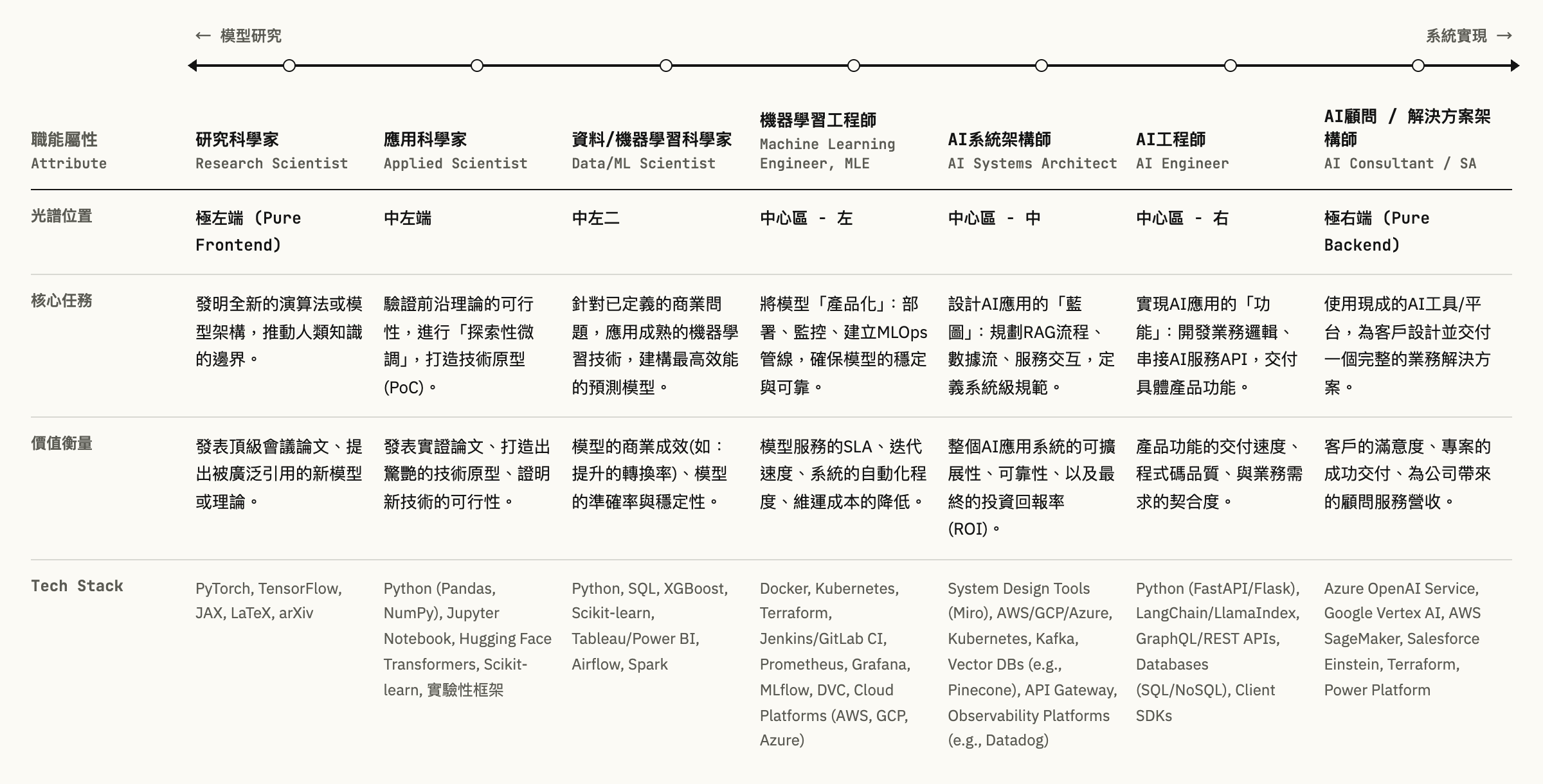
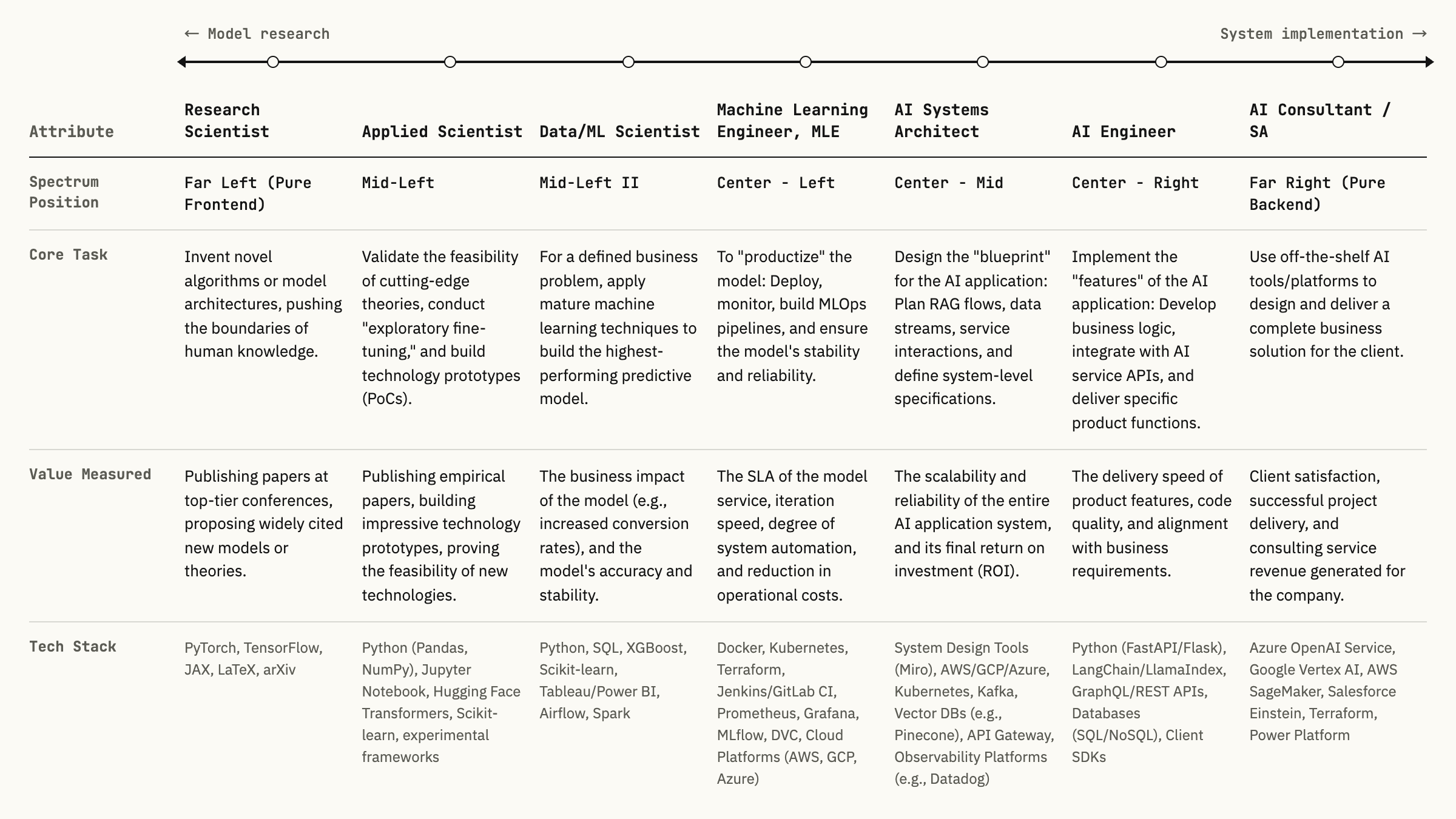
A more accurate perspective is to view AI functions as a continuous spectrum. It clearly delineates the value-creation process at every step, from pure scientific research to the final business application. To compare these roles within the same context, I will place them on a spectrum that runs from “model research” to “system implementation.”
AI Job Spectrum
This more granular spectrum clearly delineates the difference between an “Applied Scientist” and a “Data Scientist”: the former is a pioneer exploring unknown possibilities, while the latter is a master craftsman who uses mature technologies to create stable value for businesses.
More importantly, it unpacks the most critical engineering zone between “model” and “product.” It is no longer a vague “center,” but an “engineering trilogy” composed of three key roles:
The Machine Learning Engineer (MLE) turns models into stable, callable services.
The AI Systems Architect designs a grand application blueprint using these services and other system components.
The AI Engineer implements the final product features according to that blueprint.
A typical output from an AI Systems Architect is not just a technical specification document, but a complete business and technical battle plan. For example, it would clearly define a phased implementation strategy:
Phase 1: Focus on building a stable, secure, and observable private AI infrastructure (e.g., a production-grade RAG system).
Phase 2: On this foundation, plan high-value applications that generate significant business returns (e.g., personalized data analysis, enterprise-grade intelligent search).
Phase 3: Ultimately, through more advanced technologies (e.g., domain-specific model fine-tuning), build a deep technical moat that competitors cannot easily surpass.
Good News for Backend Engineers: The “90/10 Rule”
This spectrum model, especially the functions from the center to the right, is good news for the vast community of web backend engineers. Because for a production-grade AI application, “90% is the backend engineering we are already familiar with.”
The ability to dance with uncertainty: Designing systems to manage the probabilistic outputs and potential hallucinations of models.
AI/LLM “systems intuition”: Deeply understanding concepts like embeddings, prompt engineering, and context windows, and applying them to system design.
A data-centric mindset: Treating data quality and version control as first-class citizens in system design.
A new paradigm of evaluation and monitoring: Beyond system metrics, also monitoring model performance, data drift, and API costs.
Backend engineers are only that final 10% of key knowledge away from becoming the most sought-after AI talent in the market.
Conclusion: Finding Your Place on This New Map
In the age of AI, career paths are no longer single ladders. We all need to become “strategists” who know how to find our position on the map and plan our path forward.
For individuals: This map can help you self-assess. Where are you now? In your future development, do you want to deepen your expertise towards the left of the spectrum, pursuing the pinnacle of technology? Or do you want to expand towards the right, maximizing your business impact?
For companies: Companies should use this map to examine their team configurations. Are you only hiring a large number of “AI Engineers” but lack the “Architects” who can define the system blueprint? A clear positioning is what leads to precise hiring.
On this new continent of AI, we need not only brave explorers but also navigators who can draw the maps and guide the way. No matter where you are on the spectrum, clearly understanding your own position and the value of other roles is the sustainable way to navigate this rapidly evolving market.